Saturday, May 30, 2020

Giving Thanks Always


By George M. Graham Jr.


We had been up in the air, flying for about two hours. The entire time I had been looking out of the windows of the small aircraft cabin. As I observed the views, I sat in utter amazement.

It was a beautiful day. The sky was as blue as it could be, and you could see for miles and miles in every direction. The only clouds in the sky were far off in the distance.
Down below, I could see a variety of shades of green from all types of vegetation.

Across the landscape were numerous trees and forests. There were different assortments of crops in the fields. They were all lined up in what appeared as manicured rows.

The other thing that was so amazing was the diversity of shapes, sizes, and colors of the bodies of water. There were small ponds, winding streams, or rivers, and large lakes. The hue of shades of each body of water ranged from blue-green to muddy brown.

It was an impressive sight to behold! It reminded me of a verse of scripture in Genesis 1:31a, “And God saw every thing that he had made, and behold, it was very good.” It made me feel blessed and thankful to be part of such an impressive and magnificent plan.


Earlier, we had flown out of a small airport in northeast Indiana. We were flying to New Orleans for a four-day conference. The pilot, Mike Fisher, and his wife Becky were in the front seats of the plane. Morgan Smith and I were seated in the back. We had all become close friends while we were attending a small bible college in Indiana.

The plane belonged to Mike and his wife. They were farmers from Texas and used the plane to go back home, on occasion, and check on their family farm. Morgan was a well-rounded athlete who was very active in Acrogymanastics. He was from New Orleans and was excited about going back home to be able to visit with old friends and family.

Mike and Becky offered for Morgan and me to fly with them to the conference. They knew that we wanted to attend, but we would be hard-pressed, as college students, to afford the plane tickets for the trip. Their generous offer allowed us to be able to attend the conference.

Before leaving the airport, as we were loading our luggage, Mike taught us about his plane. He told us that in most cases, accidents that occurred in this type of aircraft were due to pilot error and not to mechanical problems. Mike then proceeded to share with us all about his experience as a pilot. I think he was trying to clam any apprehension that we might have about flying the long distance in a small plane.

Our trip to New Orleans went well, and we had a great time at the conference. As we began our flight back to Indiana, we were excited and talkative about all the things we had learned and the sights we had seen.

We made a stop for fuel and food about halfway back. As we got ready to leave, Morgan asked if he could change seats with Becky to be able to sit in the front. He had expressed an interest in learning more about flying, and this would allow him to observe Mike and all the instruments. Little did we know this move proved to be providential in the outcome of our trip.

As we were flying, the weather began to change. We must have entered a storm front because the rest of the trip was extremely cloudy with very little visibility. We could not see the ground below us. This ride back home was not nearly as smooth as it had been on the trip going to New Orleans. It quickly became uncomfortable, and I was getting a little uneasy.


Mike maintained communications with air traffic control as we traveled. He checked in with the local airport in Indiana as we approached our final destination. They confirmed they had us on their radar screen. We were all glad that we were getting close to home.

All of a sudden, there was a loud explosion, and smoke began pouring into the cabin of the plane. The engine started to sputter, and the aircraft started to lose altitude. As we were coming out of the clouds and got closer to the ground, we could see a highway directly in front of us. It was jam-packed with traffic flowing in both directions.

While endeavoring to maintain control of the plane, Mike was calling in a “mayday” to the local airport. The plane’s engine cut off several times. Somehow he managed to get it started again, each time it did. During all this commotion, he looked at us with a concerned look on his face. He shouted, “Start praying!” Of course, he didn’t need to say that because we were already praying as hard as we could.

You may have heard people talk about how they saw their entire lives flash before them when it appeared they were about to die. That was not the experience that I had. I knew deep down inside that God was somehow going to pull us through this safely. Amazingly, instead of fear, I felt calm and peaceful.

Since the highway directly in front of us was so busy, Mike veered the plane to the left. As we made a half-circle turn, the plane was heading straight towards a sizeable Amish barn. It appeared to be over two stories tall. On the other side of the barn were giant power lines that you typically see running through the countryside.


At that point, the plane cut off again, but Mike was able to get it started one more time. The engine came on long enough for us to clear the barn and the power lines. Just as we were past them, the engine cut off for the last time.

As we descended, we were plunging towards a large open field that looked freshly plowed. As the ground started rising closer and closer, Mike told Morgan that when he gave him the signal, he needed to help pull back on the steering column.

As the wheels started to touch the ground, they began sinking into the mud. As the wheels went in the muddy ground, the back of the plane began to flip forward. The aircraft was about to flip over completely, but the left-wing hit the ground in such a way that it kept us from flipping. Miraculously, this pushed us back into an upright position. Thankfully, we didn’t flip over. Even though this crash shook us up, no one was hurt.

Later, Mike related to us that he was very concerned about landing the plane in the field because of all the rain. He knew the ground was going to be soft and muddy. Mike knew it would probably be a rough landing. He also knew that there would be a higher possibility of flipping the aircraft. Therefore, greater risk for casualties.

The air-traffic control had notified the highway patrol. Within minutes of our crash landing, a highway patrolman pulled onto the scene. He relayed to us that he had been praying as he drove to our location. Just a few weeks before, he had gone to the scene of another crash. What he found upon his arrival at that scene was much more profound. When he arrived, everyone was already dead.

We read in Ephesians 5:20, “Giving thanks always for all things unto God and the Father in the name of our Lord Jesus Christ.” This “near-death” experience caused me to think about the many things for which I have to be thankful that day. I gave thanks to God for keeping us all safe and for His grace and mercy in our situation.


Every once in a while, I reflect on that scenario, especially when things are not going my way or are very stressful. What we experienced that day, reminds me that no matter how bad things look at the moment, God always provides a way where there appears to be no way. All of us in the plane that day could have died, but God had other plans in mind. And, I am thankful He did!

Sunday, March 19, 2017

The Journey Continues


George M. Graham Jr.

This is the second in a series of articles on the topic of Your Personal Leadership Journey.


As a leader, you will be faced with many choices that you will make along your journey. You will find that many of these choices will be easy to make, but there will be times when you have to make some difficult decisions.

You will discover by having a personal mission statement as your foundation, choices and decisions will be a little less difficult. This is because you have taken the time to recognize your personal values, fundamental beliefs, and principles that are important to you. And, you have integrated those into your personal mission statement.

By taking the time to reflect and become self-aware of what is important to you, you begin to find your true voice. In their book, Learning Leadership, Kouzes, and Posner describe the process of finding your true voice as a merging of lessons you have learned from looking out and looking in. Looking out is defined as what you learn and acquire from the experiences of others through reading, workshops, training programs, etc. Looking in is awakening to who you are on the inside and determining what is of utmost importance to you.

By merging what you have learned from others (looking out) and who you are (looking in), you come to a “turning point in your development as a leader.” You begin to speak with your words and act in agreement with your way of doing things – your style. Kouzes and Posner state, “Authentic leadership cannot come from the outside in. It comes from the inside out."

Being an authentic leader is being true to who you are and what you believe based upon your synthesizing what you have learned from others and through your personal experiences. “You cannot lead out of someone else’s experience. You can only lead out of your own.” Listen to your heart and be true to your values.


As you invest time to develop more of an understanding of yourself, it is important to realize that as other individuals go through this process, they may see things differently than you do. You are who you are because of your genetics and your experiences. Everything you have experienced up to this point in your life has contributed to the way that you perceive the world and how you react to it. This applies to every person.

Everyone perceives aspects of the world differently. Stephen R. Covey describes this perceiving process in his book, The 7 Habits of Highly Effective People, as our paradigm – a theory or explanation of things. He further explains that we interpret everything we experience through this paradigm. “We simply assume that the way we see things is the way they really are or the way they should be.” This leads to the attitudes we have and the behaviors we exhibit. In essence, “The way we see things is the source of the way we think and the way we act."

We all have different perspectives. It does not necessarily mean one way is right and another way is wrong. The point is each of us perceives things differently, which may result in our coming to different conclusions and reacting in various ways.

The following is posted on The Myers and Briggs Foundation website, “Perception involves all the ways of becoming aware of things, people, happenings, or ideas. Judgment involves all the ways of coming to conclusions about what has been perceived. If people differ systematically in what they perceive and in how they reach conclusions, then it is only reasonable for them to differ correspondingly in their interests, reactions, values, motivations, and skills.”

Our genetic makeup and life experiences contribute to each of us having different personalities. According to The Myers and Briggs Foundation, which is considered to be one of the leading authorities on personality types, there are sixteen distinct personality types. Although there are different tools for evaluating personality types, the Myers-Briggs Type Indicator (MBTI) personality inventory is probably the most well known and respected. If you are interested in finding out more information, you can go to http://www.myersbriggs.org/

Acquiring knowledge about your personality type can help you to understand why you take the actions you do and why you reach the conclusions you do. It will help you to be more aware of why others do things differently and how you may be able to work with them in more efficient ways. This knowledge will aid you in appreciating differences in other people.

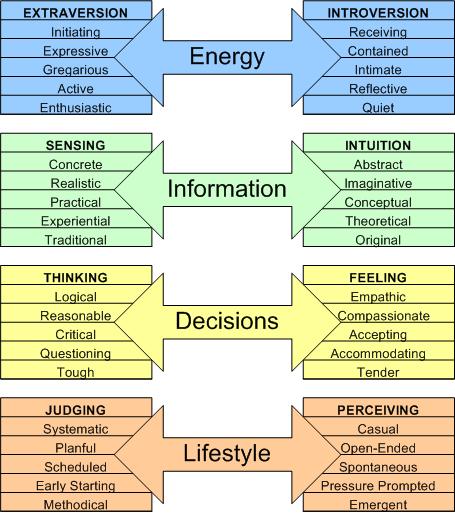
The MBTI helps an individual understand his/her personality preferences. In the chart below, the middle column lists the four dichotomies with the left and right columns listing the eight areas of comfort, or preferences for an individual. Each of these eight areas has a letter assigned. For example, Extraversion is the letter E and Introversion are the letter I. Once the person chooses his/her preference in each category, their personality type is represented by a combination of the codes, for example, ESFP would be a combination of Extraversion, Sensing, Feeling and Perceiving. The MBTI has a description for each of the 16 personality types to help the individual understand more about his/her personality preferences.


Having an awareness of personality types as part of your foundation on your leadership journey should help you to understand why there are different leadership styles. A review of articles, books, and research shows that Kurt Lewin’s research in 1939 found three major leadership styles. Recent information suggests there may be as many as eight different leadership styles.

The leadership styles may have different names, depending on the article or research you read, but each has characteristics that can be easily observed. There are those who feel most comfortable making all the decisions and telling everyone what to do and how to do it. They are more autocratic or authoritarian. They typically do not want other’s advice and feel they have more knowledge and skills than their staff members.

At the other end of the spectrum, you have those who feel more comfortable allowing staff to make decisions but who still maintain responsibility for those decisions. This style is considered to be more laissez-faire. It is often used when the individual has a lot of trust and confidence in the staff, and he/she will delegate because the staff has the needed knowledge and skills.

Of course, there are other leadership styles on the continuum between these two extremes. Other names you may hear used include transactional, democratic/participative, diplomat, and idealist, just to name a few. Each of these styles has characteristics and ways of carrying out actions in different situations. It is important to keep in mind that there is not necessarily one style that is better than another. Each one is different and depends on the individual’s personality, comfort level, and the situation that is being dealt with at a particular time.

In looking at some of the different leadership styles, the chart below by Daniel Goleman, author of Emotional Intelligence, and Primal Leadership provides great information about some different leadership styles. Goleman provides some insight by describing leader characteristics, resonance, impact (the degree of positive or negative), and when the style is appropriate.


Click on the chart to expand for readability.


Each of us has a leadership style or a combination of styles we feel most comfortable using. However, it is important to understand that you may use more than one leadership style depending on the circumstances of a situation. As the chart above shows, there are times when one leadership style is more appropriate than others.

Being able to adopt the appropriate leadership style to different situations can produce powerful results. Although you may not feel comfortable or as confident in using some of the other leadership styles, it is helpful to know you can develop yourself in these leadership styles with practice. Learning to use different leadership styles in the appropriate situations is all part of your personal leadership journey.


Thursday, January 5, 2017

Your Personal Leadership Journey

by George M. Graham Jr.


"A journey of a thousand miles begins with a single step." Lao-Tzu


John C. Maxwell, in his book, Developing the Leader Within You, states, “Ask ten people to define leadership, and you’ll probably receive ten different answers.” Although there may be many opinions about what leadership means, Mr. Maxwell sums it up simply, “Leadership is influence.” This means that leadership is the action of influencing others by way of leading, inspiring, and motivating.

You may not think of yourself as a leader, but we are all leaders to some degree. Eyes and ears are always observing, listening and studying what we do, what we say, and how we act in any given situation. You never know who may be watching and listening. You never know what kind of impact you may have on another person’s life.

We influence others as a parent, a family member, an employee, or in other capacities such as a participant at social gatherings or in organizations. We set an example for others, which can be good or bad. The example you set is entirely up to you.

I remember painfully learning this lesson when I was younger and in the early stages of fatherhood. Occasionally, when things did not go right, I would get frustrated and say, “Damn it.” One day while sitting at my desk working, my three-year-old son was playing close by. As he was playing, I heard his little voice say, “Damn it.” Needless to say, it caught me by surprise and made me aware of how important it was to pay attention to my words and deeds.

Each of us is the sum total of all the experiences we have been through. Every person, place, or thing we have interacted with, has had some impact on making us who we are at this point in time in our lives. This contributes to who we are and why we do the things the way we do.

Leadership is about making a difference in the lives of others. It is about having and maintaining relationships with those who follow you. It is about serving others to help them to grow and develop to be their best.

Who comes to mind when you think about someone that is an important role model for leadership? Who is the person that made a difference because of their leadership example in your life?

In their book, The Truth About Leadership, James M. Kouzes, and Barry Z. Posner share data they have collected over the years regarding responses to who people consider the most important role model for leadership in their own lives. The greatest percentage of responses from their data indicate that people are more likely to list a family member as their primary role model for leadership. According to the data, a teacher or coach usually comes in second. And, in third place, they often list a community or religious leader.

What quality stands out, about the person you chose, that you admire most? What is it about that person that impressed you enough to think of him/her as an important role model for leadership? Why is that quality important to you?

Many individuals rate the following characteristics as the top four most admired qualities of a leader: honesty, forward-looking, inspiring, and competent. Kouzes and Posner describe in their book that the data from their research demonstrate these top four characteristics have not changed significantly over time. Furthermore, there is little variation regarding the responses they receive by demographics, type of organization, or cultural differences. They report that the thing that is most striking about the results is that these four qualities continuously receive an average of 60% of the highest ratings of all the qualities listed.

These findings would indicate that a greater part of the population wants leaders who are credible, who demonstrate integrity and character in their actions and uphold the values they most cherish.


There was a man that lived in the 1800’s who was a Swedish chemist and was known for being the inventor of dynamite. He held over 355 different patents and opened over 90 armament factories. When his brother passed away, a French newspaper mistakenly printed an obituary about the Swedish Chemist stating, “The merchant of death is dead.”  The obituary was widely circulated and described him as the man, “who became rich by finding ways to kill more people faster than ever before.”

This situation allowed the Swedish chemist to read his obituary while still being alive. It made him realize that this was how people were going to remember him and he did not want that to be the case. He had an opportunity to reassess his life and to change his mission in life. This man was Alfred Nobel and went on to establish the Nobel Prize which recognizes outstanding contributions to humanity in many categories.

In this example about Alfred Nobel, he had an opportunity that not many people have of being able to see what others thought of his life before he died. In the chapter entitled, “Principles of Personal Leadership,” from his internationally known book, The 7 Habits of Highly Effective People, Stephen R. Covey talks about beginning with the end in mind, and he describes the importance of developing a personal mission statement. He shares that a personal mission statement, “… focuses on what you want to be (character) and to do (contributions and achievements) and on the values or principles upon which being and doing are based.”

Beginning with the end in mind, allows you to think about what you want your legacy to be when you are gone. It allows you to start with the destination in mind. It allows you to evaluate what is paramount to you, what matters most and helps to provide direction on where you want to go.

Covey describes beginning with the end in mind as being based on the principle, “All things are created twice. There’s a mental or first creation and a physical or second creation to all things.” You have to begin by defining in your mind your values, your vision, your goals – developing a blueprint so to speak. Then you put the image that you prepared in your mind into action, in the physical realm.

Covey uses the example of the construction of a home to explain how things are created twice. When you want to build a new home, you develop a plan of all the details of what you want the house to look like – a blueprint. You have a clear sense of everything about the house before you ever begin to build it. Once that design is finalized and approved, then you start the action phase in the physical realm of building the house.

As a leader, it is of vital importance that you understand your personal values, who you are, what you believe in, what you stand for, and what you want to accomplish. Having a clear understanding of these things will help you when it comes to making decisions about your life and will impact those whom you lead.

With that in mind, you now have the opportunity to reflect, visualize, and design your own personal mission statement. This mission statement is not something that you want to write quickly. You need to give it some deep thought and consideration. It may take many rewrites, but it has to be something that you feel completely comfortable with and expresses your real values and direction.

You will want to review your personal mission statement from time to time. You may find that as you grow, develop, and mature that you may need to make some adjustments. It will be a continual work in progress, but the fundamentals will stay the same. This personal mission statement will be your own constitution, similar to the Constitution of the United States of America. There have been some amendments, but the foundational principles have lasted the test of time.

Remember to write your personal mission statement as an affirmation. A good affirmation has five essential ingredients: it’s personal, it’s positive, it’s present tense, it’s visual, and it’s emotional. This will help you visualize it and program it into your mind which will allow you to put it into action in the physical realm. Research shows that many athletes use visualization. "They see it; they feel it; they experience it before they actually do it. They begin with the end in mind."

Victor E. Frankl, an Austrian neurologist and psychiatrist, Holocaust survivor and author of the book, Man’s Search for Meaning, says, “We detect rather than invent our missions in life.” He goes on to say, “Everyone has his own specific vocation or mission in life…Therein he cannot be replaced, nor can his life be repeated. Thus, everyone’s task is as unique as is his specific opportunity to implement it.”


Thursday, December 3, 2015

Miracle Workers Making A Difference

by George M. Graham Jr.

The following article is a modified version of a presentation that I made on November 19, 2015, for the Exceptional Children's Teachers of Excellence ceremony, at the 65th Conference on Exceptional Children, in Greensboro, N.C. It was an honor and a privilege to be able to speak to over 3,200 attendees including over 110 Exceptional Children's Teachers of Excellence who were honored at that ceremony.


____________________________________________________________________________________________________________________________________________________

I started work in the field of special education the same year that Congress enacted the law that would guarantee students with disabilities the right to a Free Appropriate Public Education (FAPE). Being there from the beginning, so to speak, has provided me with opportunities and experiences that have helped me to learn and grow.

I want to share with you five keys that I learned over the years to be helpful in all endeavors of life. The five keys are Passion, Motivation, Relationships, Persistence, and Thankfulness.


PASSION

In his book, The Element - How Finding Your Passion Changes Everything, Ken Robinson tells the story of Mick, who attended a boarding school in England in the 1950's. Mick had a family who loved and supported him. He also had great friends, but he did not do well in school and was very frustrated and unhappy.

Although Mick's teachers thought he was bright, according to testing he lacked intelligence, and he was failing miserably. His performance in academics confounded his teachers. Even though there was not an official diagnosis of learning disability in those days, Mick acknowledges that he had a learning disability.

One thing that Mick really loved to do was bang and tap on things all the time. He had an epiphany when he visited his sister in London. He went with her to a nightclub to hear a group of jazz musicians perform. His dream of being a drummer was born that night.

At sixteen, with his parent's permission, he moved to London with a set of drums to pursue his passion. Through a series of fortunate breaks, Mick eventually became one of the founding members of the band, Fleetwood Mac. Mick, of course, became one of the most famous drummers in the world - Mick Fleetwood.

Someone once said, "God's gift to you is your potential. Your gift back to God is what you do with that potential." I encourage you to continue to learn, grow, and develop your passions. Incorporate your passions, whatever they may be, into your job. You may be surprised by what may happen when you do.


MOTIVATION

Motivation is a force that drives us to action and influences our behavior. Motivation is the driving force behind passion. John Lennon said, "There are two basic motivating forces: fear and love. When we are afraid, we pull back from life. When we are in love, we open to all that life has to offer with passion, excitement, and acceptance." The motivational force of love is what makes a difference.

When I was a little boy, my friend Jimmy and I used to ride our bikes and go exploring for miles around where we lived. One of the places we liked to go was Rowan Street Park. Back in those days, there was an elderly black gentleman, whom everyone referred to as King, that lived on the edge of the park property. He lived in an old shack that was inside a wooden fenced area that also housed other smaller buildings, to include an outhouse. He had no electricity or running water.

We were always fascinated by this place because it looked like a fort to us. One afternoon, as we were riding by, my curiosity got the best of me. I saw King outside feeding his ducks and chickens. We stopped, and I asked him a question about his animals. King graciously invited us in to show us all of his animals.

He proceeded to show us a variety of different animals. He concluded with showing us a mother possum and all her babies that were inside a big empty oil drum. He talked with us about each his animals. He told us that they knew they were safe as long as they stayed inside of the property. Then, he sat us down and read stories to us from the Bible. To be honest, it was an afternoon I will never forget.

I do not believe that King had a mean bone in his body. His only motivation was love. He impacted my life that day in a big way, because of his love for all his animals, his love for the Bible, and his willingness to share his heart with us. By the way, I think there is a point to be made about the motivational force of love and longevity because King lived to be 108 years old.

We intuitively know that our heart represents who we are. It is love that flows from your heart, the innermost part of your being, that will guide you in making the right decisions. Trust your heart and live your life by the motivational force of love. It will guide you in helping you to be your best and in making a difference.


RELATIONSHIPS

Relationships are the foundation of all aspects of life. As you all know, any relationship takes a lot of work. There are times when we may feel that we are at the "end of our rope" with a parent, staff member, or even an administrator. Here is a little strategy to use when this happens. I call it Heart of Compassion.

How many of you have a pet or have owned a pet. Many folks treat their pet just like a member of the family and are very compassionate about their pets because they are very near and dear to their hearts. By using the word PET as an acronym, we can see a simple example of steps to take in developing a heart of compassion. The acronym stands for Practice Empathy and Thankfulness.

Here is the strategy - when you are frustrated with someone, think about your pet and focus on the tenderness and compassion you have for your pet. Allow those feelings to be a springboard in helping you to have tenderness and compassion with the person who is so challenging to you. Having these feelings should help you to be able to listen more actively, to seek to understand the other person's point of view, to focus on things you have in common and not on your differences, and in helping you to build trust.

Think about your pet to use your heart of compassion in developing and maintaining relationships with others.


PERSISTENCE

There are times when we all get discouraged, and we may want to give up and quit. Persistence is a refusal to give up or let go. It is an obstinate continuance in a course of action in spite of difficulty or opposition. The following story was shared by Joel Osteen in his book, The Power of I Am.

In 1995, a young lady gave birth to twin girls that were born prematurely. One of the preemies had a severe heart problem and wasn't expected to live.

The hospital's policy was to keep the babies in separate incubators. Several days passed, and the one baby continued to go downhill and was very close to death.
One of the nurses felt that the babies should be put in the same incubator as they had been in their mother's womb. After much hard work and much persuasion, she convinced the hospital to make an exception to their policy, and they put the babies in the same incubator side by side.

Overnight, somehow the healthy baby managed to put her arm around the sick little sister. Much to everyone's surprise, the little sister's health started to improve. Her temperature came back to normal. Her heart stabilized. Little by little, day after day, she got better and better.

Today, both of those young ladies are alive and healthy thanks to a nurse who was persistent in taking the right course of action.

Persistence takes self-discipline, determination, and intestinal fortitude. Don't ever give up on yourself or your students. Stay focused on the results, taking one step at a time, as you persist in making a difference.


THANKFULNESS

We are quickly approaching the time of year that we remember to give thanks for all of our many blessings. Our goal should be to count our blessings every day. Live life with an attitude of gratitude.

About a year ago, I was reminded of this in a very vivid way. I was working out behind our house where we have three levels of retaining walls to keep the dune from eroding.

I was at the top of the first retaining wall and somehow fell forward, flipping my body and hitting my head on the second level retaining wall. Falling approximately 12 feet, I found myself wedged in between the house and the bottom of the third retaining wall in a dazed state.

I was laying on my left side on top of my left arm and the left side my face was in the sand. I realized at this point that I could not move the entire right side of my body. I could feel blood running down my face. I coughed, and when I did, I spit up blood. I knew I had to move because I was having trouble breathing.

After what seemed like hours, I dragged myself from the back side of the house around to the front steps. I made it up the first flight of steps to the front door just as my wife was coming out to check on me. I realized then how thankful I was that my wife is a nurse because she immediately took charge and kicked into the nursing mode.

At the emergency room, the findings indicated two fractured vertebrae in the upper back and neck area and damaged ligaments along the spinal column. The next day I saw a neurosurgeon and after reviewing all my tests he said it was a miracle that I was not dead or paralyzed from the neck down.

Within a couple of days, I went to see my dentist for some x-rays because of numbness I was experiencing from hitting my head. I will never forget as I was leaving the office, the dentist said to me, "George, evidently God is not done with you yet."

Ladies and gentlemen, I tell you the same thing tonight, "God is not done with you yet." Each and every day you work miracles with the children you teach by making a difference in their lives. It is because you have a passion for what you do, love motivates you, you build a relationship with your students, parents, and peers, you don't give up even when you want to quit, and you do it all with an attitude of gratitude.

Every time one of your students walks across the stage at graduation; you are witnessing a miracle. A miracle that you helped to make happen.

Ladies and gentlemen, I am truly grateful for each and every one of you and the difference you make because you truly are miracle workers.

Thursday, October 1, 2015

Surfing for Autism 2015

By George M. Graham Jr.

After numerous hours of planning and preparation, the Surfing for Autism 2015 event occurred on August 14th and 15th at Jeanette's Pier in Nags Head, North Carolina. It was the sixth annual event, made possible by the efforts of many amazing volunteers, local surfers, and the contributions from community businesses.


Logo by Jake Slagle

I had been asked to arrive mid-afternoon on Friday, the 14th to welcome and greet folks as they arrived at Jeanette's Pier. The first scheduled occurrence was the Meet and Greet, which started around 5:30. At this time, families had dinner provided and had the opportunity to meet others who are there to participate in the event.

During the Meet and Greet, there is usually the official welcome, announcements, recognitions, and a raffle. Little did I know, I was about to be completely surprised by what was going to happen at this presentation.

I had heard that photographer Bob Sumners was to be recognized. His wife, Ann, who is one of the Surfing for Autism Board members, was giving the speech for the recognition. It had been kept a secret up until this moment.

I sat down toward the front to be able to video what was about to happen. As I did, I thought to myself, "Isn't it awesome that Ann gets to make the presentation to her husband, Bob."

As Ann began reading her prepared speech, I was grinning from ear to ear in anticipation of Bob's being recognized. However, the further along she got into her speech, what she was saying didn't sound like it applied to Bob. As she came to the end of the speech, I was shocked to realize that she was speaking about me.

(L. to R.) Mark Slagle, Jennifer Lunceford, Eileen Lowery, Ann Sumners, George, Jean Graham, Becci Shealey, and Lisa Ammons.

I was honored to be the recipient of the Eric Gardner Memorial Award. Although it totally blew me away, I was very blessed to receive this recognition. I appreciated the members of the Surfing for Autism Board selecting me to be the recipient of this great honor.

The plaque I received was in the shape of a surfboard. At the top of the board was my name, with the Surfing for Autism logo and Surfing for Autism Outer Banks, NC 2015 in the middle. Just below, it reads, "Eric Gardner Memorial Award. In appreciation for your dedication, generous support and giving spirit. May you realize the countless smiles, encouragement, and hope, you bring to all those involved with Surfing for Autism."


Eric Gardner was an Outer Banks local whose coffee shop, Southern Bean, kept people awake and focused for years. He was a dedicated father, husband, and surfer who supported Surfing for Autism (SFA) with all he had. Eric passed away unexpectedly in 2013 and SFA honors him by an annual award given to someone who exemplifies Eric’s love for SFA, dedication to community, and passion for helping the children we serve.

After the Meet and Greet had concluded, the siblings of the participants in Surfing for Autism were provided the opportunity to go fishing. The participants and their families watched a special social story to help them to prepare for what would be happening. Then, the participants had a chance to get surfing lessons from the surfers down on the beach.

Watch the Social Story video below!


The next day, Saturday, August 15th, the main event took place. Over the years, the annual event has grown, not only with the number of participants but more importantly, with all the folks who come out to be part of the event. This year there were over 80 participants and the largest crowd of supporters that have ever attended.

Surfing for Autism was started in 2010 by Eileen Lowry and Mark Slagle, who are parents of children with autism. At the time, Eileen was the president of the local chapter of the Autism Society of NC. She met Mark, a local surfer, and they developed a plan with the help of several other educators and surfers which resulted in the first annual Surfing for Autism event. That year there were over 30 participants who were able to surf at no cost to their families.

Watch highlights from the Surfing for Autism 2015 below!


The mission of Surfing for Autism is to offer individuals and families impacted by Autism Spectrum Disorder (ASD) a supportive environment to connect and share by creating opportunities to experience the therapeutic benefits of surfing. Through these opportunities, Surfing for Autism is also creating a greater awareness and a deeper understanding of ASD within the community.

For more information about Surfing for Autism go to http://www.surfingforautism.org/


Saturday, May 30, 2015

On Being Hearing Impaired

By George M. Graham Jr.

I have a confession to make. I am a flower child from the 1960's. It transpired as the result of many influences, but mostly because of the "British Invasion". The music of the Beatles and other groups from England had such an impact on my life; I wanted to play music and eventually became a drummer.

AP Photo

Being a drummer and playing music in the 1960's and 1970's provided many positive experiences. Unfortunately, one of the adverse side effects of playing music during those years was that I suffered a hearing loss. The loud volume of music and the length of time of the exposure were the causes. The diagnosis is what is called a noise-induced hearing loss.

As part of the aging process, many people lose some of the quality of their auditory ability, especially in the higher frequencies. When I had my hearing tested in my mid-twenties, they informed me that I had the hearing of a 60 to 65-year-old man. I had lost my ability to hear some of the higher frequencies and it was starting to deteriorate in the range of typical human voices.

When we are young, many of us think we are invincible. We don't often think about the long term effects or realize the full consequence of wrong choices we make. If I intended to continue to play loud music, there were things I needed to do to help prevent my hearing loss from getting worse. Some of those things I implemented, but the one thing I should have done, to wear ear plug protection when playing, I did not do.

George M. Graham Jr. - Playing music - 1970

It was not until later in life when I realized how bad my hearing was becoming, that I finally started wearing ear plug protection when playing. It did help me tremendously, but as part of the aging process, my hearing has continued to deteriorate somewhat.

It was not until I was in my early fifties, after much coaxing from my wife, that I finally consented to get fitted for hearing aids. I am so grateful that I did because it has made all the difference in the world for me.

Simple sounds that I did not realize that I was no longer able to hear, such as birds singing, I was able to hear again with the help of hearing aids. They increased my ability to hear better on the telephone. I was able to carry on conversations and understand much more of what was being said than I had before.

One of the great benefits for my wife was the fact that I did not have to play the television or music as loud. Previously, in the car I would have a CD blaring so loud, she would have to wear ear plugs herself. Unfortunately, she probably suffered the consequences of my stubbornness to go and get hearing aids.

I went to see Dr. Lewis Gidley in Greenville, N.C. I had known Lewis when we both attended East Carolina University. He was also a fellow musician and knew about the type of hearing loss I had. After doing the typical evaluations, Lewis knew what to recommend for me.

For anyone with a hearing problem, I highly recommend that you seek out professional help to figure out the best options for you. Do not put it off. Do not be hard-headed like I was. The longer you wait, the more you will be missing out on the quality of life that you could have with the proper assistive technology.

healthyhearing.com

There are some things you need to know if you are going to get hearing aids. It takes some time to adjust to them. Do not be impatient with yourself. Allow yourself time to get used to them.

As an example, after I got my initial hearing aids, we had a two-hour drive back home in my van. Part of that trip was on the interstate. The road noise that I was not able to hear before was almost deafening to me. Then it started raining, and the patter of the rain on the roof of the van was more than I could take. I had to take out the hearing aids for the rest of the trip home.

You may find that you will need to move slowly with the implementation of wearing your new hearing aids. It may be helpful to take a break from them for short periods of time as your hearing and brain learn to readjust to what you have not heard for a while. It takes two to three months of wearing hearing aids to become completely comfortable and to realize the full benefits.

For those who do not have hearing impairments, I would like to ask you to consider the following and ask that you endeavor to empathize with those who have difficulty hearing.
  • When talking on the telephone, especially when leaving a voice mail message - please slow down and speak distinctly. Often I have trouble with consonants, especially at the beginning or ending of a name. I sometimes find it necessary to ask someone to spell out the name for me to make sure I got it correctly. I also have difficulty with names and phone numbers in voice mail messages when a caller speaks too quickly. There are times when I have to ask someone to help me decipher the message.
  • Sometimes in social situations, like in a restaurant or at a social gathering, it may seem that those of us with hearing impairments may not socialize as much. Please realize it is not because we are anti-social, but it is sometimes hard for us to be able to hear amongst all the other noise in this type of environment. It can be embarrassing to us when we have to keep asking people to repeat themselves. Therefore, it may be easier to keep to ourselves.
  • When speaking with someone with a hearing impairment, try to look directly at them. Sometimes, we need to see the lips in to help us process the words being spoken. We read body language, facial expressions, and tone of voice to help us to process what it is that is being spoken. All those things help us when we are not able to distinguish some of the words being spoken.
  • Please realize there are times when we do not respond as quickly to questions or things being said.  It could be because we are processing everything (lips, body language, facial expression, and tone of voice) to make sure we heard what you said correctly. Be patient and allow us time to process and respond.
  • Having a hearing impairment can be very draining. Estimates are that a person with a hearing impairment uses up to 50% of their energy on communication during each day, whereas those without hearing impairments may only use as little as 5% of their energy. In conversations, it takes more energy for us to focus to be able to distinguish sounds and filter out background noises.

Hearing Health Foundation (hearinghealthfoundation.org)

Current estimates are that 30 out of every 1,000 school-aged children have a hearing loss. Further, estimates are that one out of five teens suffers from a hearing loss. Because it is an invisible disability, we cannot see a hearing loss, parents and educators should be aware of some of the signs or effects. You may notice a child continually asking you to repeat what you have said. You may see a change in the child's personality, such as aloofness or confusion. The child may mumble and say words incorrectly, or may not participate in group discussions. The child may talk louder than others. The child may complain of ringing in the ears (this is called tinnitus).

I share the following advice, especially for all of you young folks and musicians, and I speak from first-hand experience. Please remember to protect your hearing. When being exposed to loud noise, don't forget to wear ear plugs. Do not play your music overly loud when using earbuds or headphones - this can cause damage that you do not even realize is happening at the time. Finally, if you realize that you are having difficulty with your hearing, please seek out professional help as soon as possible.